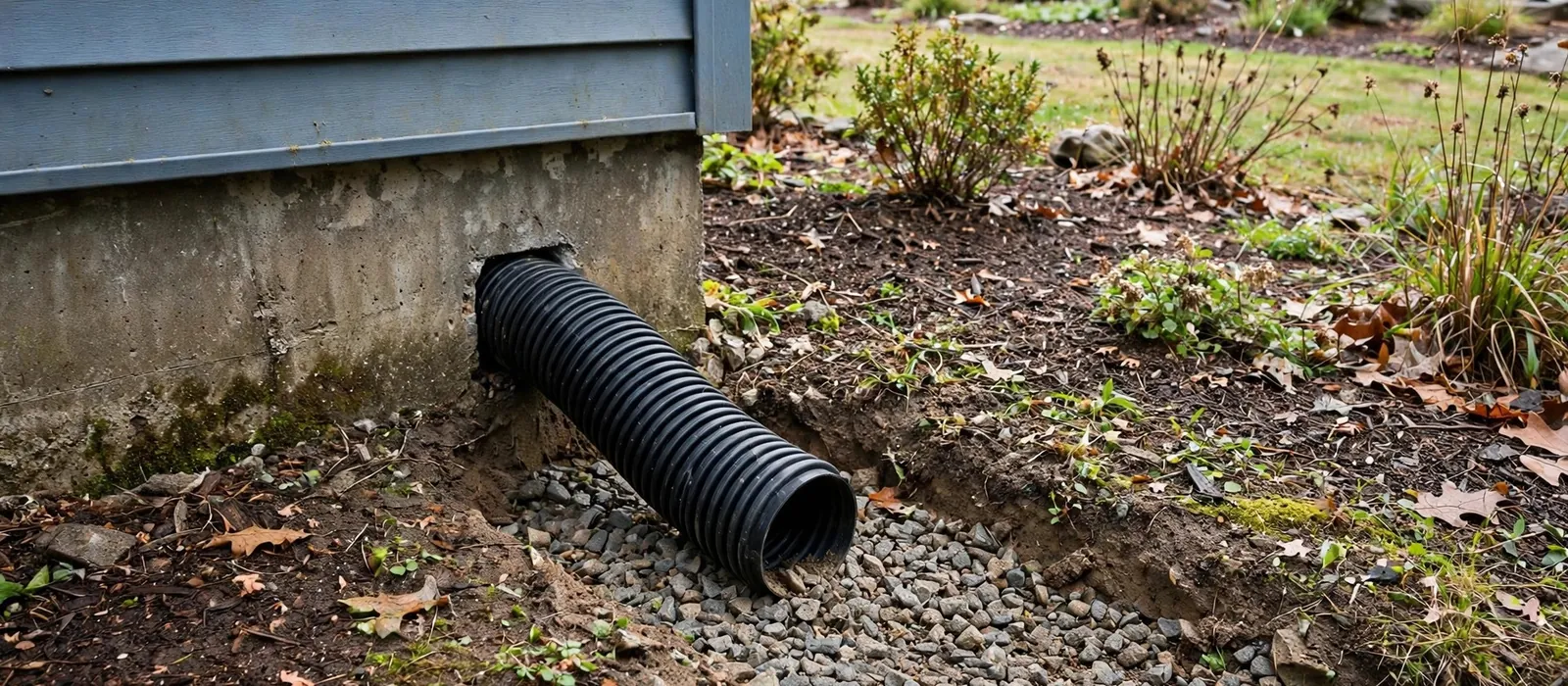
Cleaning underground gutter drains in Independence, KY starts with one question: is the clog near the top, or deep in the buried pipe? If water boils out of the downspout elbow, a hose flush from the top often clears it. If water backs up again within minutes, the blockage is farther down and needs a cleanout or a drain machine.
A buried downspout line is usually 3 or 4 inch PVC or corrugated plastic pipe that carries roof water away from the foundation. It has no trap and no vent, so debris that enters just sits there. Over a few seasons, shingle grit, leaf mush, and thin roots fill the pipe slowly. This guide covers the signs, the flush method, cleanouts, roots, and the point where you should stop.
What a buried downspout line actually does
Rain runs off the roof, into the gutter, and down each downspout. At ground level, many homes connect that downspout to a pipe that runs underground, often downhill to a pop-up emitter in the yard, a curb outlet, or a storm connection. The pipe is sloped about a quarter inch per foot so gravity keeps water moving.
Because it only handles clean rain, nobody thinks about it until it fails. That is the problem. Roof grit from asphalt shingles is sand-like and settles at low spots. Maple seeds, oak leaves, and pine needles wash in and mat together. Add a bit of silt and the pipe starts to behave like a slow sieve instead of a drain.
Signs the underground line is backing up
You do not need to dig to know something is wrong. Most blockages announce themselves during a heavy rain, when the pipe is asked to move the most water.
Downspout overflows at the top
Water spills over the gutter edge or shoots out of the elbow joint instead of flowing down. That points to a full pipe below.
Gurgling at the elbow
Air is being pushed back up as water fights a partial blockage. You will hear it during storms.
Soggy ground along the pipe path
A strip of wet or sunken lawn between the house and the outlet can mean the pipe has cracked or separated.
Water at the foundation
Pooling beside the wall means roof water has nowhere to go. Left alone, it can find its way into a basement or crawl space.
Outlet runs dry in a storm
If the yard emitter or curb outlet stays dry while the roof pours, the line is blocked somewhere in between.
Muddy staining on siding
Splash-back from an overflowing downspout leaves a dirty band on lower siding and sometimes a green film on concrete.
Flushing the line with a garden hose
Try this first on a dry day, working from the top. You need a hose, a spray nozzle, work gloves, and a bucket. Do not use chemical drain cleaner, since it is made for sink traps and does nothing useful in a rain pipe.
Clear the gutter first
Scoop leaves and grit from the gutter near the downspout by hand. If the gutter keeps dumping debris, the pipe will clog again.
Disconnect the downspout elbow
Remove one or two sheet-metal screws at the bottom of the downspout and slide it off the underground inlet. Check inside for packed leaves.
Pull out what you can see
Reach in with a gloved hand or a bent coat hanger and drag out mat and mud. Drop it in the bucket, not back in the yard.
Feed the hose into the pipe
Push the hose a few feet into the inlet with the water running on a strong jet. Work it in and out as the flow opens.
Run water and watch the outlet
Walk to the exit point. A steady stream of muddy water that turns clear means the line is open. No flow means the blockage is farther down.
Reconnect and test
Screw the elbow back on and run the hose from the roof edge for two minutes. If the downspout stays calm, you are done.
Buried drain not clearing?
Call our 24/7 line and describe what the hose is doing.
Why roots, not leaves, are the stubborn clog
Roots find buried rain pipes because the joints sweat moisture on warm nights, especially where two sections meet. A hair-thin root enters a gap the width of a pencil line and then thickens into a mat that catches silt. A garden hose cannot cut that mat, and pushing harder just packs it tighter.
If your hose stops at the same distance every time, a root mass or a collapsed section is the likely cause. Plumbers use a small drain machine with a cutting head for roots, or a camera to see the joint before deciding what to do.
Which fix fits which symptom
Use this as a quick decision guide before you pick up tools or a phone.
| What you see | Likely cause | Best first move |
|---|---|---|
| Overflow only in the heaviest rain | Debris near the top of the line | Hose flush from the downspout |
| Hose water backs up after a few feet | Packed mud or a root mass | Locate the cleanout and try again, or call |
| Dry outlet, wet lawn midway | Cracked or separated pipe | Stop flushing and call a plumber |
| Same clog returns each season | Low spot or poor slope in the pipe | Camera check, then repair plan |
| Water appears inside the basement | Blocked line plus foundation seepage | Call now, then see our drain cleaning work |
| Gutter full but pipe flows freely | Gutter debris, not the pipe | Clean the gutter and add a leaf guard |
Finding and using a cleanout
A cleanout is a capped pipe stub that gives you direct access to the line. Not every home has one, but many newer installations include them where the line turns.
- Look for a round 3 or 4 inch cap flush with the ground or in a small valve box near the downspout.
- Walk the likely path from each downspout toward the yard, curb, or driveway edge.
- Wear gloves and eye protection before you open the cap, since trapped water can spray out.
- Unscrew the cap slowly and let any standing water drain before reaching in.
- Feed a hose or a small hand-crank drain auger in the direction of the blockage.
- Replace the cap hand-tight with the gasket seated so soil cannot wash in.
- Mark the cleanout location on a sketch of your yard for next time.
Banklick Creek, SD1, and where your pipe ends up
Banklick Creek is a Kenton County creek that flows into the Licking River, and Sanitation District No. 1 (SD1) handles stormwater management for the area. That matters because the end of your downspout line is not a private matter once water leaves your yard. Where it discharges can affect a neighbor, a street ditch, or a public storm system.
Before you redirect a downspout line to a new outlet, ask SD1 or the City of Independence what is allowed. Rules differ by property, so a quick call is cheaper than relocating a buried pipe twice. If you are cleaning an existing line that already works, you generally do not need to change where it ends.
Source: City of Independence history page and SD1 listing (municipal and utility)
When to stop and call a plumber
Stop when the hose will not pass a certain point, when you find water bubbling up in the yard, or when you see a depression forming above the pipe. Those are signs of a broken or collapsed line, and more water pressure will only wash soil into the break. Our crews use hydro jetting to scour stubborn lines and a camera to find the damage.
Also call if you cannot tell whether a pipe is a rain drain or tied to the sanitary sewer. Some older homes have mixed connections, and flushing the wrong one can send water where it should not go. A plumber can trace the line and tell you which is which. Our 24/7 emergency line is there for flooding that will not wait.
Keeping the line open once it is clear
Clean gutters at least twice a year, once after spring seed drop and once after leaves finish falling. Fit mesh guards if tall trees overhang the roof. Flush the buried line with the hose in the same visits so grit does not settle.
Trim or remove fast-growing shrubs and young trees within a few feet of the pipe path. Roots follow moisture, so a maple planted over a joint will find it eventually. If you live near the Taylor Mill side of town, our crews also serve Taylor Mill and Elsmere with the same line-clearing work.
Frequently asked questions
A pressure washer with a drain-line nozzle can work, but it is easy to damage thin corrugated pipe or push debris into a crack. A garden hose on full jet is safer to try first. If the hose fails, a professional machine with the right head is the better next step.
Rain pipes normally exit in the yard or at the curb, not into the house sewer. If your downspout vanishes into the ground with no visible outlet, a plumber can trace it with a camera or locator. Do not assume. Connecting roof water to the sanitary sewer can overload it.
Once a year is a fair baseline for homes with trees nearby, and more often if you see overflow during storms. Homes with no trees and good gutter guards may go longer. The pipe gives clues: if the outlet runs slow, flush it.
Ask first. Banklick Creek is a tributary of the Licking River in Kenton County, and SD1 manages stormwater for the area, so the discharge point matters. Contact SD1 or the City of Independence before moving an outlet. Cleaning an existing line is a different matter and normally does not change where water goes.
Roots often return if the source tree is still close and the pipe joint is still open. Cutting them gives you a season or two. A lasting fix means sealing or replacing the joint, or moving the pipe path away from the tree.
Sources and official contacts
Local details in this guide come from the sources below. They are the right offices for questions about the water and sewer systems or plumbing rules.
- Sanitation District No. 1
Handles sewer and stormwater, and takes sewer emergency reports.(859) 578-7450 - Kentucky Division of Plumbing
Oversees plumbing in the state, including the State Plumbing Code that sets the standards for our work. Verify a plumber's license or ask about permits here.(502) 573-0397