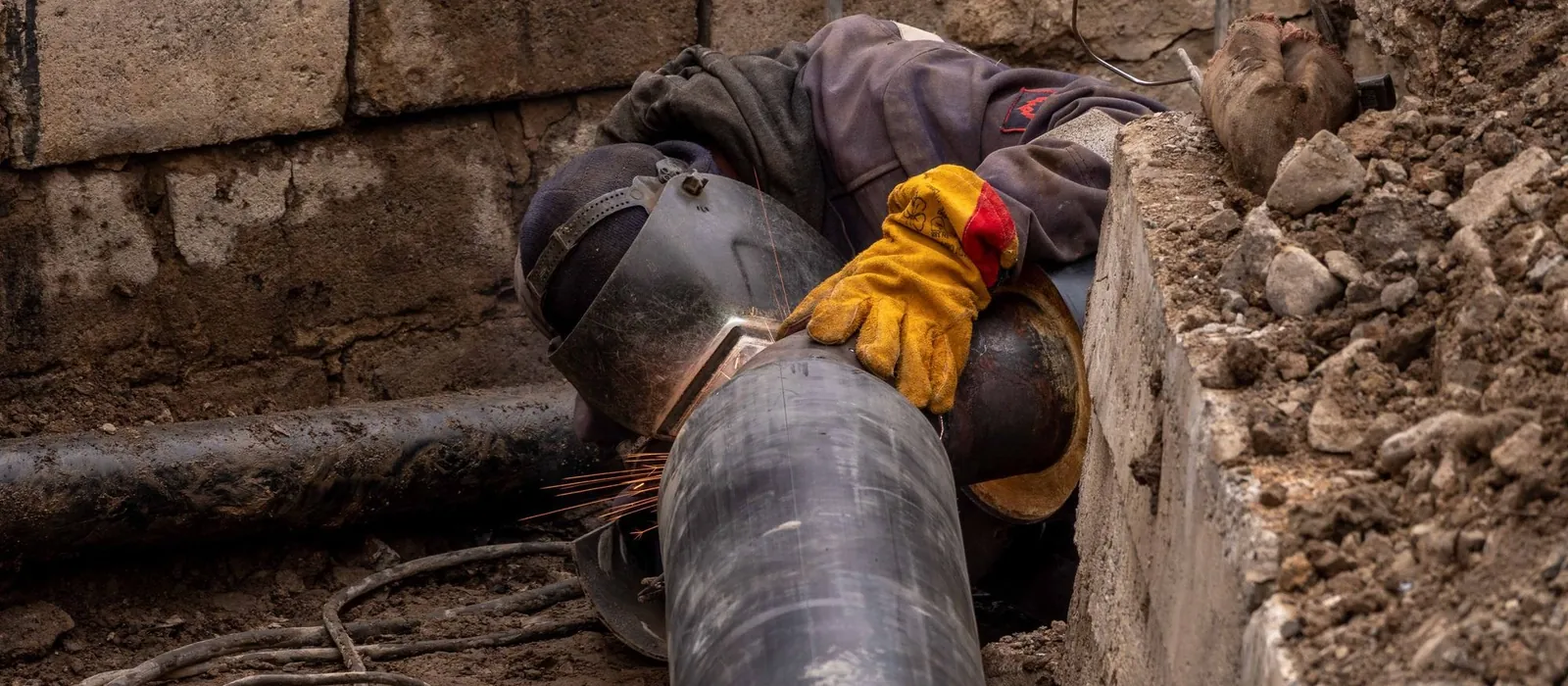
A broken water line shows up as a soaked patch of yard, a meter that keeps turning with every tap closed, or a house that suddenly has no water. For water line repair in Independence, KY, first learn which side of the meter the problem sits on. Our licensed plumbers handle the part you own, and our 24/7 line is open when the leak cannot wait. Close the main valve inside the house.
The service line is the buried pipe that carries water from the street main to your house. You rarely see it, so damage tends to surface as a wet lawn or a drop in pressure. Older lines are often copper or galvanized steel, newer ones are usually plastic such as polyethylene, and each material fails in its own way.
Leak before the meter or after it? Ownership decides who fixes it
Northern Kentucky Water District owns the line from the main to the meter. You own the rest, from the meter to the house. That split matters before anyone picks up a shovel. A leak on the street side belongs to the utility, so you report it to NKWD customer service. A leak on the house side is your repair, and that is the work we do.
To sort out which side you have, shut off every fixture and watch the small dial on the meter. If it moves, water is escaping somewhere. Now close the main valve inside your house and look again. A dial that stops points to a leak in your indoor plumbing, and a burst pipe repair call may be the better fit. A dial that keeps moving means the loss is upstream of that valve, in the buried line.
Leave the meter box alone and do not dig near it. If the wet spot sits close to the street, call the utility first. If our technician finds the break on NKWD's side, we tell you so you do not pay for a repair that belongs to someone else.
Signs the buried line is leaking or giving out
Most failures start small and grow for weeks before anyone notices. These are the signs that usually lead us to the service line.
Soggy or sunken ground
A patch that stays wet in dry weather, or a dip in the lawn or driveway, often sits right above a leak.
A meter that moves at rest
With every fixture off, a turning dial means water is going somewhere it should not.
A higher bill with no new habits
A slow leak can run around the clock and quietly add thousands of gallons to a month.
Weak flow at every fixture
When showers, sinks, and hose bibs all drop together, the supply into the house is the first place to look.
Brown or cloudy water at first draw
Corroded steel or a breach that lets soil in can tint the water after it sits still.
The hiss of running water
A faint rush in a quiet house, heard near the entry point of the line, suggests a pressurized leak.
Water gushing outside or gone from the house: do this first
A cracked or pulled-apart line can empty gallons a minute, wash out soil under a driveway, and leave a house dry. Our after-hours crews take calls at any hour, and same-day appointments are often available for lines that are leaking but contained.
Your job while you wait is to limit damage and keep access clear for the technician.
- Close the main shutoff valve inside the house, turning the handle until it stops.
- Open one faucet at the lowest level of the house to drain pressure from the pipes.
- Keep children, pets, and vehicles away from soft or sinking ground.
- Photograph the wet area and the meter dial so the technician sees the starting point.
- Move anything valuable out of a basement or crawl space that may take on water.
- Call our 24/7 line and say whether the water is still flowing.
Unsure which side of the meter it is?
Describe what you see and our licensed plumbers will help sort it out.
Spot repair, partial replacement, or a new line
The right fix depends on what the pipe is made of, how long the damage runs, and how many other weak spots exist. This table shows how technicians usually decide.
| What we find | Usual approach | Why it makes sense |
|---|---|---|
| One clean break in sound pipe | Cut out the bad section and splice in new pipe | The rest of the line is healthy, so a short repair solves it |
| Several pinholes along old galvanized steel | Replace the full run from meter to house | Steel corrodes from the inside, so new leaks tend to follow |
| Crushed or shifted plastic line | Replace the damaged stretch with new pipe | Crushing weakens the pipe wall beyond what a coupling can fix |
| Leak at the house wall or foundation entry | Repair the entry point and fittings | Movement and mixed metals are common failure points there |
| Line under a driveway or slab | Trenchless replacement or a reroute, if the site allows | This avoids tearing up hard surfaces that cost more to restore |
A technician may find a mix of these on one property. When the steel has pinholes in several places, the conversation often turns to repiping the house supply as well.
What a technician actually checks before digging
Digging is the expensive part of the job, so the work starts with confirming where and why the line failed.
- Read the meter with every fixture off and confirm the leak is real.
- Shut the house main and test whether the loss continues upstream of it.
- Identify the pipe material at the entry point, whether copper, steel, or plastic.
- Measure static water pressure with a gauge on an outdoor spigot.
- Walk the likely path of the line and check for wet or sunken ground.
- Use listening gear or tracing equipment to narrow down a buried leak.
- Check the house-side shutoff valve, since a failing valve can mimic a line problem.
- Note what sits above the line, such as concrete, trees, or a septic or sewer run.
Low water pressure: when the line is the cause and when it is not
Low pressure at every faucet does not always mean a broken line. Many homes sit between 40 and 80 psi, and a gauge on an outdoor spigot tells us where you fall. A reading far below that range, or pressure that fades through the day, sends us looking at the supply side of the house.
Common causes include a half-closed main valve, a failing pressure reducing valve, steel pipe narrowed by mineral buildup, and a leak that bleeds off flow before it reaches the fixtures. A leak in the buried line often comes with a wet yard or a rising bill, which separates it from the others.
If only one bathroom runs weak, the cause is usually local, such as a clogged aerator or a partly closed stop valve. We check for hidden leaks and test the pressure at more than one point before suggesting any digging.
What changes the price of a water line job
No two lines cost the same to fix, because the pipe is out of sight and the ground above it varies. You get a clear price before work starts, once the technician has seen the site.
Length of the run
A short repair near the house takes far less labor and material than a line that crosses a long front yard.
Depth and soil conditions
Deeper trenches and rocky or clay-heavy ground slow the digging and raise the labor involved.
What is on top of the line
Driveways, patios, trees, and landscaping must be cut, moved, or restored, and that work can rival the plumbing itself.
Pipe material and fittings
Copper, plastic tubing, and the valves or couplings at each end are priced differently.
Repair method
A trench is the standard approach, while trenchless methods suit some sites and change both the tools and the cost.
Homeowners insurance often responds to sudden damage inside the home, such as water from a burst pipe, but rarely pays to replace a line that simply wore out. Read your own policy, since service line coverage is sold separately by some insurers.
How a line replacement unfolds on site
Locate and mark
We confirm the path of the old line and mark it on the ground so the trench follows the right route.
Shut off and isolate
The house main is closed and the line is separated from the meter connection on your side.
Open the ground
We dig a trench, or bore a path where the site allows, and expose the old pipe.
Set the new pipe
New pipe goes in at a steady slope with proper bedding, then connects at both ends with fittings made for the material.
Test and flush
We pressurize the line, check every joint for seepage, and flush it so debris does not reach your fixtures.
Backfill and restore
The trench is filled in layers and compacted, and the surface is returned as close to its original state as the job allows.
Frequently asked questions
It can be, but check the basics first. Look at the meter, confirm your neighbors still have water, and make sure the main valve inside the house is fully open. If the street is dry, call NKWD. If only your house is dry, a failed line or valve on your side may be the cause, and we can diagnose it.
Yes. Our 24/7 line takes water line calls at night and on weekends in Independence. Close the main shutoff valve inside the house first, open a low faucet to drain pressure, and keep everyone off the soft ground. Then call us with a note on whether water is still flowing.
NKWD owns the line from the main to the meter, so that stretch is the utility's responsibility. Report it to NKWD customer service. We will tell you plainly if our technician finds the break on that side, so you only pay for work on the part you own. Neighbors in Elsmere and other nearby towns can call the same line.
Often, yes. Listening and tracing equipment can narrow a buried leak to a small area before any digging starts. Concrete, depth, and background noise affect accuracy, so we confirm the spot before opening the surface.
Material depends on when the line was installed, so you cannot tell by the age of your street alone. NKWD asks customers to report their service line material and offers lead testing through its water quality line. A technician can also identify the pipe where it enters the house.
Yes, we repair house-side and outbuilding water lines on your property. The same approach applies: find the leak, decide between a splice and a replacement run, and price it before we start. Long runs and hard ground raise the labor involved.
Only if the line is the cause. A gauge reading, a look at the main valve, and a check of the pressure reducing valve come first. If the buried pipe is leaking or choked with buildup, replacing it can restore flow. If the problem is elsewhere, we say so before you spend money.
Sources and official contacts
Utility and licensing facts on this page come from the offices below. Contact them directly for anything on their side of the line.
- Northern Kentucky Water District, customer service
Owns the service line from the main to the meter and publishes an annual water quality report.(859) 578-9898 - Kentucky Division of Plumbing
Oversees plumbing in the state, including the State Plumbing Code that sets the standards for our work. Verify a plumber's license or ask about permits here.(502) 573-0397