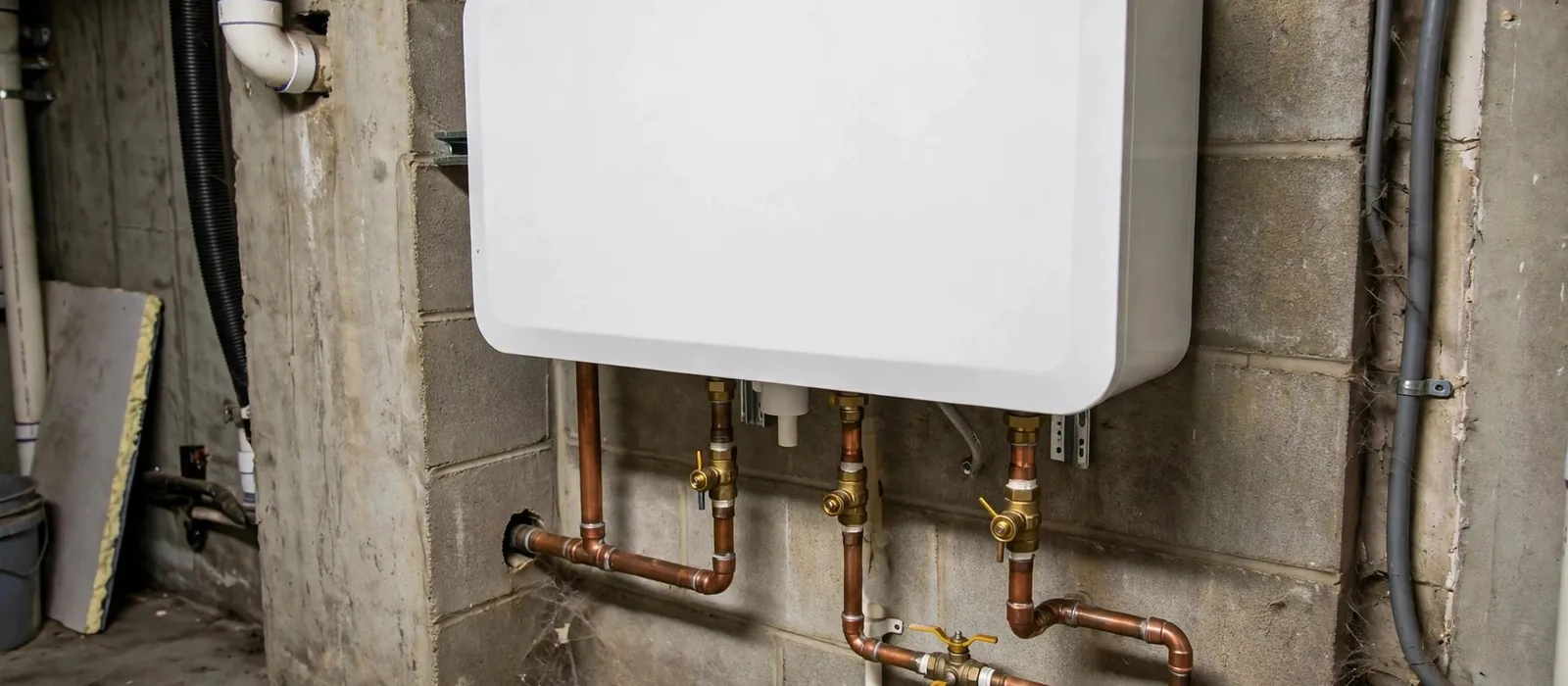
A tankless water heater in Independence, KY heats water only while a tap is open, so there is no 40 to 50 gallon tank to run empty. That is the appeal. The catch is that the unit needs the right gas line, vent, and flow rate to deliver it. Our licensed plumbers size the system to your fixtures, install it, repair it, and flush the scale out of it.
Most calls about these units fall into three groups. Some owners want to swap a tank for an on-demand heater and need to know if the house can handle one. Others have a unit that shows an error code, runs lukewarm, or drips. The rest simply want it flushed, not replaced.
We work across Independence and the rest of Kenton County. You get a clear price before work starts, and same-day appointments are available when the schedule allows.
Lukewarm showers, beeping codes and cold bursts: what the unit is telling you
Owners rarely call asking for a heat exchanger inspection. They call because the shower fades, a display flashes a number, or a puddle shows up below the unit. Those symptoms all lead back to the same technical subject: an on-demand, or tankless, water heater and the few parts that decide how well it works.
Hot water fades when two fixtures run
Every tankless unit has a maximum flow in gallons per minute. A shower plus a dishwasher can ask for more than the unit can heat, or scale inside the unit can lower that maximum.
A cold blast between hot uses
Hot water sitting in the pipe cools off while the heater is idle, so the next draw starts with a short cold slug. Some of this is normal. A long cold stretch points to a sensor or a flow problem.
An error code with a beeping sound
Most brands use numbered codes for ignition, flame, venting, and temperature faults. The code names a circuit, not a part, so the real cause still has to be tested.
Water that is hot, then not, then hot
Swings in temperature often come from a clogged inlet screen, a failing flow sensor, or mineral buildup that narrows the water passages.
Rumbling or popping while it heats
Scale on the heat exchanger traps tiny pockets of water that flash to steam. The noise is the unit telling you it needs a flush.
Water around the base of the unit
The source may be a loose fitting, a weeping relief valve, a blocked condensate drain, or a cracked heat exchanger. Shut off the water and power to the unit and call us.
What moves the price of a tankless install
Two tankless jobs on the same street can cost very different amounts. The unit itself is only one line. The pipe, vent, and electrical work around it often decide the total, which is why we price after we see the existing setup.
Gas line size and run length
A tankless burner pulls far more gas at once than a tank burner. A half-inch line that served a tank may need to become three-quarter inch, and a long run adds pipe and labor.
Venting type and route
Condensing units use plastic vent pipe and can exit through a wall. Non-condensing units need stainless venting. A longer or more twisted route costs more.
Unit capacity
A bigger household with several bathrooms needs a higher flow rating. A bigger unit costs more and may need a bigger gas supply.
Water-side parts
Isolation valves for flushing, a pressure relief valve, and a condensate drain are all part of a sound install. Adding them to an older plumbing layout takes extra fittings.
Removing the old tank and reworking the space
Draining and hauling out a tank, moving a power outlet, and patching the wall where the old vent ran all add time.
Insurance rarely pays to upgrade a working water heater to a tankless model. If a covered event such as a sudden leak destroyed the old unit, your policy may cover part of the loss, so read it or call your agent before work starts.
Tank or on-demand: how to decide for your house
Tankless is not the better choice for every home. This table lays out the trade-offs we talk through before anyone signs off on a switch.
| Question | Storage tank | Tankless |
|---|---|---|
| How does it make hot water? | Keeps 40 to 50 gallons hot all day | Heats water as it flows through |
| What happens at peak demand? | Runs out after the tank empties | Holds steady until you pass its flow limit |
| What does the house need? | Usually a standard gas or electric hookup | Often a larger gas line, special vent, and power outlet |
| What upkeep does it need? | Occasional tank flush and anode check | Scheduled descaling and an inlet screen cleaning |
| How long does it tend to last? | Roughly a decade | Often around two decades with good care |
| Where does it mount? | Floor space in a closet or basement | On the wall, freeing up floor area |
If your home already has a tight gas supply or no easy vent route, a new tank may still be the sensible pick. We would rather tell you that than sell you a project that fights the house.
Need a tankless unit looked at?
Call our line to book a visit and get a clear price before work starts.
Flush and descale: the service most owners really need
Many callers ask us to flush their unit instead of replacing it, and that is often the right call. Heating water drops minerals out of it, and a tankless heat exchanger has narrow passages where scale collects. Over time the unit heats less water, runs hotter, and starts throwing codes.
Northern Kentucky Water District's 2023 report shows about 7 grains per gallon of hardness across its systems. That is moderately hard to hard water. The report does not say which treatment plant feeds your street, so assume your unit sees scale and plan a regular flush. Check the maker's manual for the interval, since many call for about once a year in hard water.
A flush circulates a descaling solution, often white vinegar, through the heat exchanger with a small pump and two hoses for roughly 45 to 60 minutes. We then rinse the unit, clean the inlet screen, and check flame and temperature readings. Units installed without isolation valves need those added first, because the pump hoses connect there.
How an install day runs
Size the load
We add up the fixtures that might run together and pick a unit with enough flow for them.
Check gas, vent and power
We measure the gas line, plan the vent route, and confirm a power outlet and condensate drain location.
Remove the old heater
We shut off gas and water, drain the tank, disconnect it, and haul it out.
Mount and connect
The unit goes on the wall with isolation valves, a relief valve, the gas connection, and the vent.
Fire it up and test
We check for gas leaks, run hot water at several fixtures, and confirm the outlet temperature and flame reading.
What a technician checks on a misbehaving unit
A code or a cold shower tells us where to start, not where to stop. These are the checks we run before we recommend any part.
- Read the code history and match it to the manual's fault list.
- Test the gas pressure while the burner runs at full fire.
- Inspect the vent for blockage, loose joints, or a cracked section.
- Pull the inlet screen and look for debris or scale flakes.
- Measure the temperature rise between the inlet and outlet.
- Check the flame sensor and igniter for wear or soot.
- Look at the condensate trap and drain for a clog.
- Test the flow sensor with water running at a low and a high rate.
Why gas line and vent size catch people off guard
A typical tank burner draws about 30,000 to 40,000 BTU per hour. A whole-house tankless unit can ask for 150,000 to 199,000 BTU the moment a shower starts. If the old gas pipe cannot supply that, the unit starves, drops its flame, and shows a fault. This is the most common reason a brand-new install underperforms.
Repair, replace, or start over with a new install
A unit with a worn igniter, a clogged screen, or scale buildup is usually worth fixing. A cracked heat exchanger or a repeated fault after a good flush may not be. For a failing tank model that you want to keep, our water heater repair page covers that path, and water heater replacement explains when a swap makes more sense.
If you are starting fresh, see how we handle a standard water heater installation for the parts that apply to every type. We also take calls from neighbors in Edgewood, where the same gas and vent questions come up.
Frequently asked questions
The code points to a circuit such as ignition, flame, venting, or temperature, and your manual lists what each number means. Scale, a dirty screen, and weak gas supply are common causes. We read the code history and test the unit before suggesting a part.
Yes. If the heat exchanger is sound, a descaling flush often brings back normal heat and quiets the noise. We check the unit afterward so you know whether it has more life in it.
The unit may be hitting its flow limit, or the flame may be dropping out on weak gas or a vent problem. Scale and a blocked inlet screen can also cut flow. A temperature-rise test at the unit usually shows which one it is.
Northern Kentucky Water District's 2023 report shows about 7 grains per gallon across its systems, which is moderately hard to hard. Follow the interval in your manual, and many makers suggest about once a year in water like that.
It depends on the gas line, a vent route, a power outlet, and wall space. We look at all four before quoting. If the house is a poor fit, we will say so and talk through a tank instead.
No. Turn off the gas or power to the unit and close its water supply, then call us. Water near a burner or control board can damage the unit and create a safety problem.
Sources and official contacts
Utility and licensing facts on this page come from the offices below. Contact them directly for anything on their side of the line.
- Northern Kentucky Water District, customer service
Owns the service line from the main to the meter and publishes an annual water quality report.(859) 578-9898 - Kentucky Division of Plumbing
Oversees plumbing in the state, including the State Plumbing Code that sets the standards for our work. Verify a plumber's license or ask about permits here.(502) 573-0397