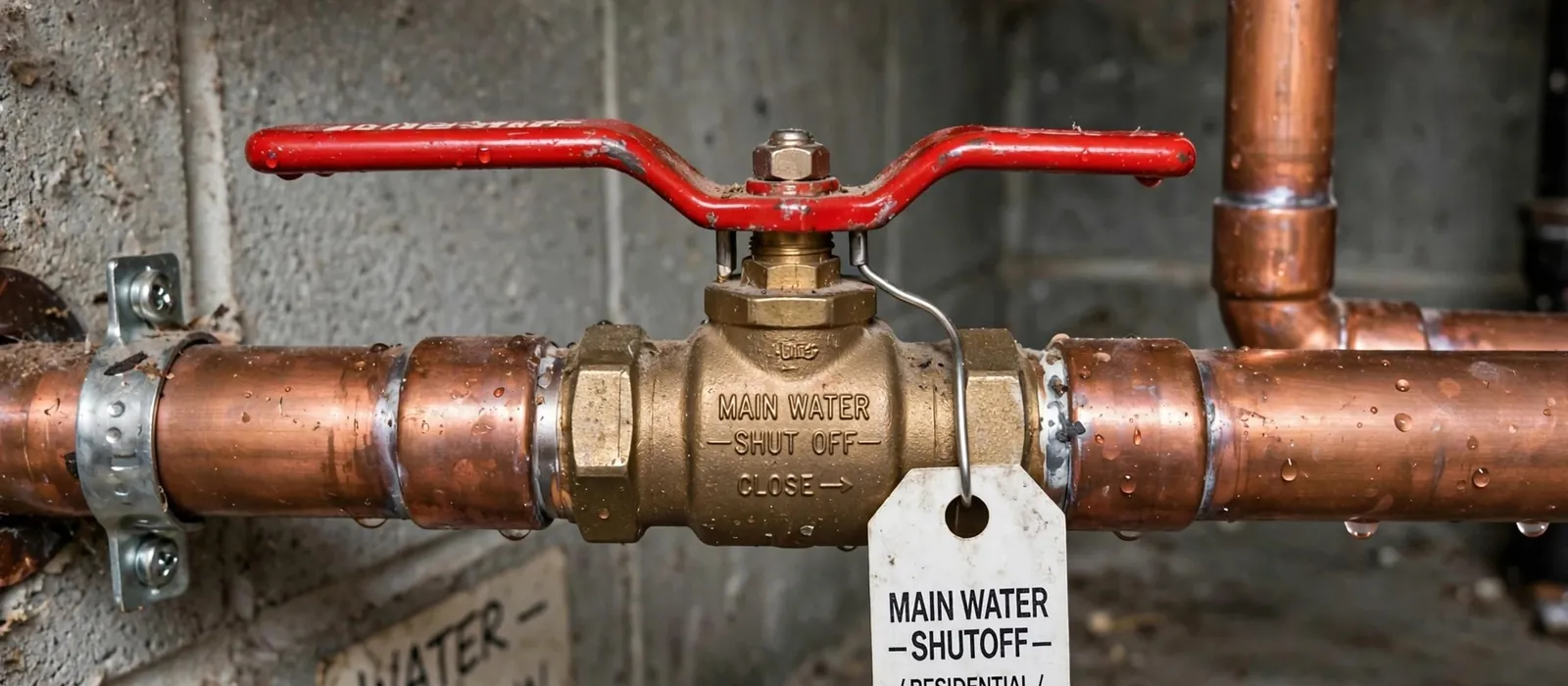
To find your main water shutoff valve in Independence, KY, follow the water line from the street to the house. The valve sits where the pipe enters the building, usually on a basement or crawl space wall that faces the street, or in a utility room near the water heater. A second valve sits at the meter outside.
The two valves are not owned by the same party, and that matters in an emergency. The one inside your house is yours to operate. The one in the meter box at the curb belongs to the water district. This guide shows how to find each, how to tell a gate valve from a ball valve, how to test yours, and how to label it.
Where the pipe comes in
Water reaches a house through a buried service line, and it surfaces at the foundation or slab. Look at the wall that faces the street first. In a basement home, the pipe usually pokes through the wall about a foot or two below the ceiling or near the floor, and it is often 3/4 inch or 1 inch copper, plastic, or galvanized steel.
Homes on a slab, with no basement, tend to hide the valve in a utility closet, a garage wall, or a mechanical room next to the water heater. Crawl space houses often have it just inside the access door. Follow the line backward from the water heater or the first cold water pipe and it will lead you to the valve.
A search routine that finds it fast
Walk the house with a flashlight and work through these spots in order.
- Check the basement or crawl space wall that faces the street, high and low.
- Look in the utility room, laundry room, and any closet that holds the water heater.
- Search the garage, especially the wall closest to the street.
- Peek behind access panels, under stairs, and behind the washing machine.
- Locate the meter outside, in a ground box with a lid near the curb or property line.
- Trace the cold water line from the water heater back toward the wall where it enters.
- If a pressure reducing valve or filter is installed, look just before or after it.
Gate valve or ball valve: how to tell
The handle shape tells you the valve type, and the type tells you how to treat it.
| Valve type | What it looks like | How it operates | Common problem |
|---|---|---|---|
| Gate valve | Round wheel handle | Turn clockwise several full turns to close | Stem corrodes and the valve will not seal or will not move |
| Ball valve | Short lever handle | Quarter turn closes it when the lever is crossways to the pipe | Lever can loosen or the seals leak at the stem |
| Globe valve | Round handle on a bulging body | Turn clockwise to close | Restricts flow even when open |
| Curb stop at the meter | Brass key-operated valve in a box | Needs a special tool | Belongs to the water district, not the owner |
If your valve is a gate valve and it is more than a few decades old, assume it may fail the first time you test it. That is useful information, not a disaster, because you can plan the replacement on your schedule.
Water will not shut off?
Call our 24/7 line and we will get a licensed plumber moving.
How to test the valve without causing a leak
Prepare the house
Open a faucet at the lowest point and another at the highest point. Tell everyone in the house that the water will be off for a few minutes.
Close it slowly
Turn a wheel handle clockwise by hand, or swing a lever a quarter turn. Never use a wrench or pipe on the handle, since that can snap a corroded stem.
Check the taps
The upper faucet should stop running within a minute and the lower one should slow to a drip. If water keeps flowing, the valve is not sealing.
Reopen it gently
Turn the handle back slowly to avoid a pressure surge, which can rattle pipes. Close the faucets once water runs clear and steady.
Look for drips
Wipe around the valve stem and the packing nut. A weeping stem is a sign the valve needs service.
Why old gate valves jam
A gate valve closes with a wedge of metal that slides down into the flow. Over years of sitting still, minerals build up on the wedge and the seat, and the stem corrodes where it passes through the packing nut. When you finally turn it, the wedge can break from the stem and spin uselessly, so the handle turns but the water never stops.
A ball valve avoids most of this. A hollow ball with a hole through it rotates a quarter turn, so there is a smaller wear surface and no wedge to snap. Many plumbers replace a stubborn gate valve with a full-port ball valve so the next emergency takes seconds, not minutes.
Who owns which valve in Independence
Northern Kentucky Water District owns the water line from its main to your meter. You own everything from the meter to the house, including the shutoff valve inside. That means the valve you can safely operate is the one in your basement or utility room, and the valve in the meter box belongs to NKWD.
If the interior valve will not close and you need the water off, do not reach into the meter pit with pliers or a wrench. Call NKWD customer service at 859.578.9898 and ask them to shut the water off at the meter. Then call us to repair or replace the interior valve.
Source: NKWD 2023 Water Quality Report (utility)
Label it and keep it ready
Once you have found the valve, tag it. A bright plastic tag or a strip of tape with the words MAIN WATER on the pipe takes one minute and helps a family member, a house sitter, or a plumber find it in the dark. Add a photo of the valve to your phone and a note about where it is.
Keep the area clear of boxes and storage. Exercise the valve once a year by closing it and reopening it, which stops minerals from locking it. Do this at the same time you test your smoke alarms so you remember.
When to call a plumber
Call a plumber if the valve leaks at the stem, if the handle spins without effect, or if you cannot find any valve at all. A missing or broken main valve is a real risk, because a burst pipe cannot be stopped without it. Our licensed plumbers can fit a new full-port ball valve and check the nearby piping.
If a pipe has already burst, shut off the main and read about burst pipe repair while you wait. A buried line that has failed is a different job, covered under water line repair and replacement. Our 24/7 emergency line is open for these calls, and clear pricing comes before the work starts.
We serve homes in Erlanger and Edgewood as well. Cost depends on the valve size, how much pipe must be cut, whether the water has to be turned off at the meter, and how hard the access is.
Frequently asked questions
It is normally on the wall where the water line enters the house, often facing the street. Look in the basement, crawl space, utility room, or garage. The line usually comes in near the water heater.
Do not use the utility's valve in the meter box. That valve belongs to the water district, and a wrong move can damage it. Use the shutoff inside your house, and call NKWD if that valve fails.
A ball valve is easier to operate and less likely to jam. A gate valve works fine when new but tends to seize with age. If yours is stiff or leaks at the stem, replacing it is a short job for a plumber.
Once a year is plenty. Close it gently, check the taps, and open it slowly. Regular use keeps mineral buildup from locking the stem.
The Northern Kentucky Water District owns the line from the main to your meter, and you own the rest from the meter to the house. Call NKWD customer service at 859.578.9898 to have the water shut off at the meter, then call a plumber for the interior valve.
If the water will be off for a while, turn off the power to an electric heater at the breaker so the elements do not run dry. For a gas unit, follow the label on the tank and do not touch the gas line. Check the maker instructions for your model.
Sources and official contacts
Local details in this guide come from the sources below. They are the right offices for questions about the water and sewer systems or plumbing rules.
- Northern Kentucky Water District, customer service
Owns the service line from the main to the meter and publishes an annual water quality report.(859) 578-9898 - Kentucky Division of Plumbing
Oversees plumbing in the state, including the State Plumbing Code that sets the standards for our work. Verify a plumber's license or ask about permits here.(502) 573-0397