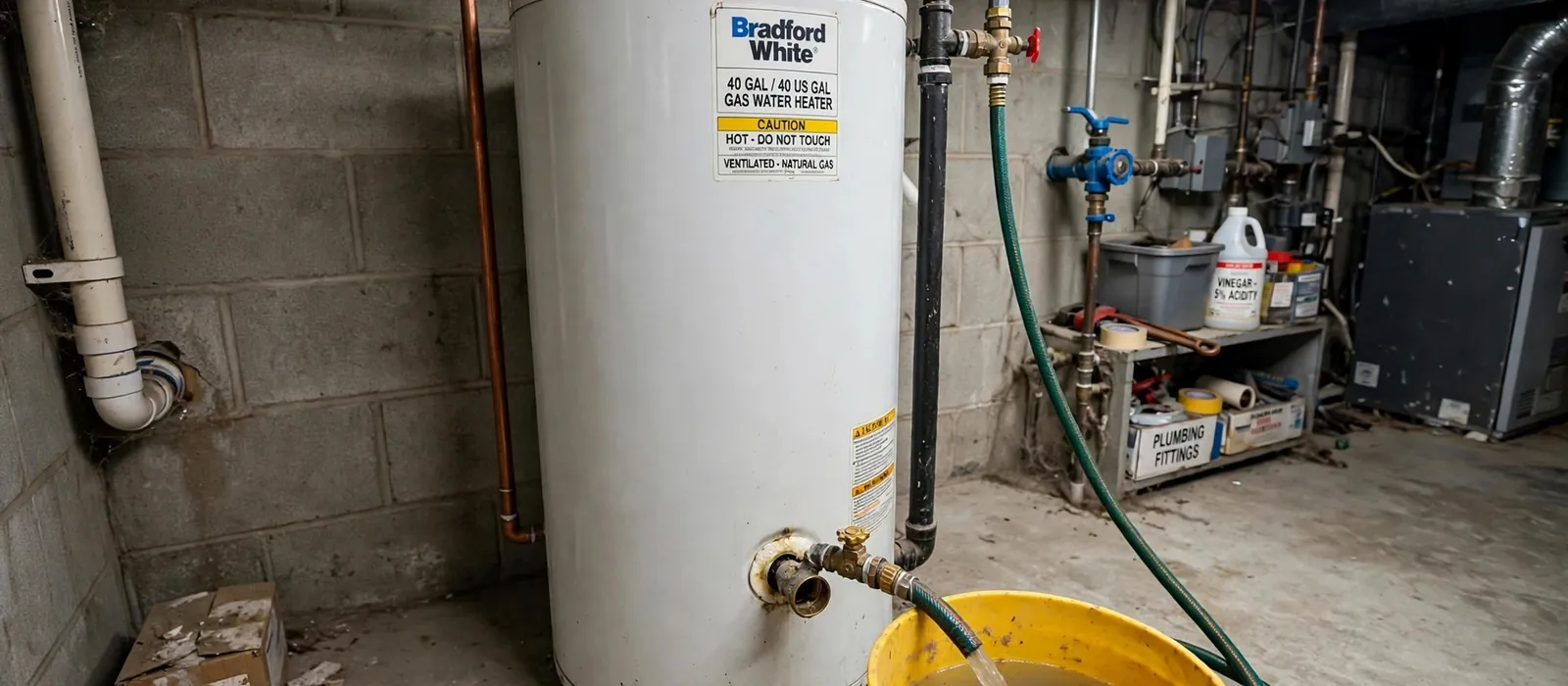
To flush a tank water heater in Independence, KY, turn off the power or gas, close the cold water valve, connect a hose to the drain valve at the bottom, and drain until the water runs clear. Then refill, purge the air, and turn the heat back on. The job takes roughly an hour and needs no special parts.
Sediment settles at the bottom of every tank, where it insulates the water from the burner or lower element and makes the unit work harder. Flushing removes much of it. Below you will find the safety rules, a full step list, troubleshooting for a stuck drain valve, and the point where a plumber should take over.
Read this first: safety before you touch the valve
Water in the tank can scald. Hot water from the drain hose is hot enough to burn skin in seconds, so let the tank cool for an hour or run hot water at a tap until it turns lukewarm. Aim the hose at a floor drain or outside, never at plants or bare feet.
For an electric heater, shut off the breaker before draining. If the elements fire while the tank is empty, they burn out within seconds. For a gas heater, turn the gas control to pilot or off. If you ever smell gas, leave the house and call the gas utility or 911 first. Do not try to fix it yourself.
Tools and parts to set out
Gather everything before you start so the tank is not sitting half drained while you hunt for a hose.
- A standard garden hose long enough to reach a floor drain or the yard.
- A bucket for the first few quarts and for checking the water color.
- A flat screwdriver, as some drain valves have a slotted stem.
- Work gloves and closed shoes for hot-water safety.
- A hose washer or two, since an old washer is the most common drip.
- A clear glass jar to see sediment, if you want to judge how dirty the tank is.
Flushing the tank, in order
Cut power or gas
Switch off the breaker for an electric unit. Set the gas control to the off or pilot position for a gas unit.
Close the cold water inlet
Turn the shutoff valve on the cold pipe above the heater clockwise until it stops. This keeps new water out while you drain.
Open a hot tap upstairs
Open one hot faucet to let air into the system. Without it the tank can form a vacuum and drain very slowly.
Connect the hose to the drain valve
Thread the hose onto the valve near the bottom of the tank and run the other end to a drain or outdoors, downhill from the heater.
Open the drain valve
Turn the valve open and let water flow. Expect cloudy water, grit, and small flakes at first.
Pulse the cold inlet to stir sediment
After half the tank empties, briefly open the cold inlet. The jet kicks up settled grit. Close it and continue draining.
Drain until the water runs clear
When the hose runs clear for about a minute, close the drain valve and remove the hose.
Refill, purge, then restore heat
Open the cold inlet. When water flows steadily from the open hot tap, close it. Only then restore power or gas.
Tank rumbling or rusty?
Call our 24/7 line and we will tell you if a flush is enough.
If something goes wrong mid-flush
Most problems are simple and have a simple answer. A few are signs to stop.
| What you see | Likely reason | What to do |
|---|---|---|
| Hose drains very slowly | No air entering, or the valve is clogged with grit | Open a hot tap, then try the cold-inlet pulse |
| Nothing comes out of the drain | Sediment has packed the valve opening | Try a pulse of cold water, and stop if it still fails |
| Valve drips after closing | Debris on the seat or a worn washer | Close it hard, re-open briefly, and cap the outlet |
| Valve handle snaps or spins | Plastic valve worn by age | Stop and call, since replacing a drain valve needs a drained tank |
| Rusty water won't clear | Tank interior corrosion | Plan for replacement soon |
| Pop or rumble after refilling | Remaining sediment boiling under the burner | Flush again at a later date |
Why sediment builds faster in Independence plumbing
The Northern Kentucky Water District's 2023 report shows average hardness of about 7 grains per gallon across its systems, and the disinfectant is chlorine. Hard water leaves calcium and magnesium scale when it heats. Over months, that mineral layer collects in the tank, covering the bottom and sometimes the lower element.
The practical result is simple. A yearly flush keeps the layer thin, the water heating efficient, and the burner quiet. Chlorine is a strong oxidizer, so a flush is also a good moment to ask whether the anode rod needs a look. Do not skip a year just because the heater seems fine.
Source: NKWD 2023 Water Quality Report (utility)
What sediment actually does inside the tank
In a gas heater, the flame heats the tank from below. A crust of scale sits between flame and water, so the steel gets hotter than it should and the burner stays on longer. Heat stress cracks the glass lining over time, and that is where rust starts.
In an electric heater, scale coats the lower element. It overheats and fails early, or the tank gives a rumbling noise as steam pockets form under the layer. If you hear popping, sediment is likely already thick. Flushing may quiet it, but a heavily scaled tank sometimes does not recover.
How often to flush, and what to skip
Once a year is a sound habit for most homes, and twice a year makes sense if the water is hard or the tank is older. Mark the date on the tank with tape so you do not guess next time.
Skip the flush if the tank is already leaking, if the drain valve is cracked, or if the unit is far past its normal life of 10 to 15 seasons. An old valve can fail when opened, and then you have a leaking tank and no way to shut it off. In that case, call a plumber and get an opinion before you touch it.
When to call a plumber
Call if the drain valve will not close, the tank leaks at the seams, you see rust at the base, or hot water comes out rust-colored after a flush. Those point to failing hardware, not routine sediment. A water heater repair visit can replace a valve, an element, or a thermostat.
If the tank is old and the flush turns up flakes of steel or lining, a swap may be the better call. Our crews handle water heater replacement and serve Erlanger and Taylor Mill as well as Independence. Our 24/7 emergency line is open if a tank is leaking and you cannot stop it.
Frequently asked questions
It is not mandatory, but it helps. Sediment builds up in every tank, and a yearly flush removes much of it. Without flushing, you pay more to heat water and the tank wears faster.
NKWD's 2023 report shows about 7 grains per gallon across its systems, which is moderately hard to hard. Water at that level leaves scale in a heated tank over time. A yearly flush is a fair schedule, and more often if you hear rumbling.
No. An electric element left on in an empty tank burns out fast, and a gas burner on an empty tank can overheat the steel. Always shut off power or gas first.
Plan on about an hour: 20 to 30 minutes to cool and drain, and another 15 to 20 to refill and purge. A very scaled tank may drain more slowly.
Brief cloudiness is air bubbles or loosened mineral bits and should clear within minutes. Persistent rust-colored water points to tank corrosion or the anode rod, and a plumber should look at it.
Sources and official contacts
Local details in this guide come from the sources below. They are the right offices for questions about the water and sewer systems or plumbing rules.
- Northern Kentucky Water District, customer service
Owns the service line from the main to the meter and publishes an annual water quality report.(859) 578-9898 - Kentucky Division of Plumbing
Oversees plumbing in the state, including the State Plumbing Code that sets the standards for our work. Verify a plumber's license or ask about permits here.(502) 573-0397