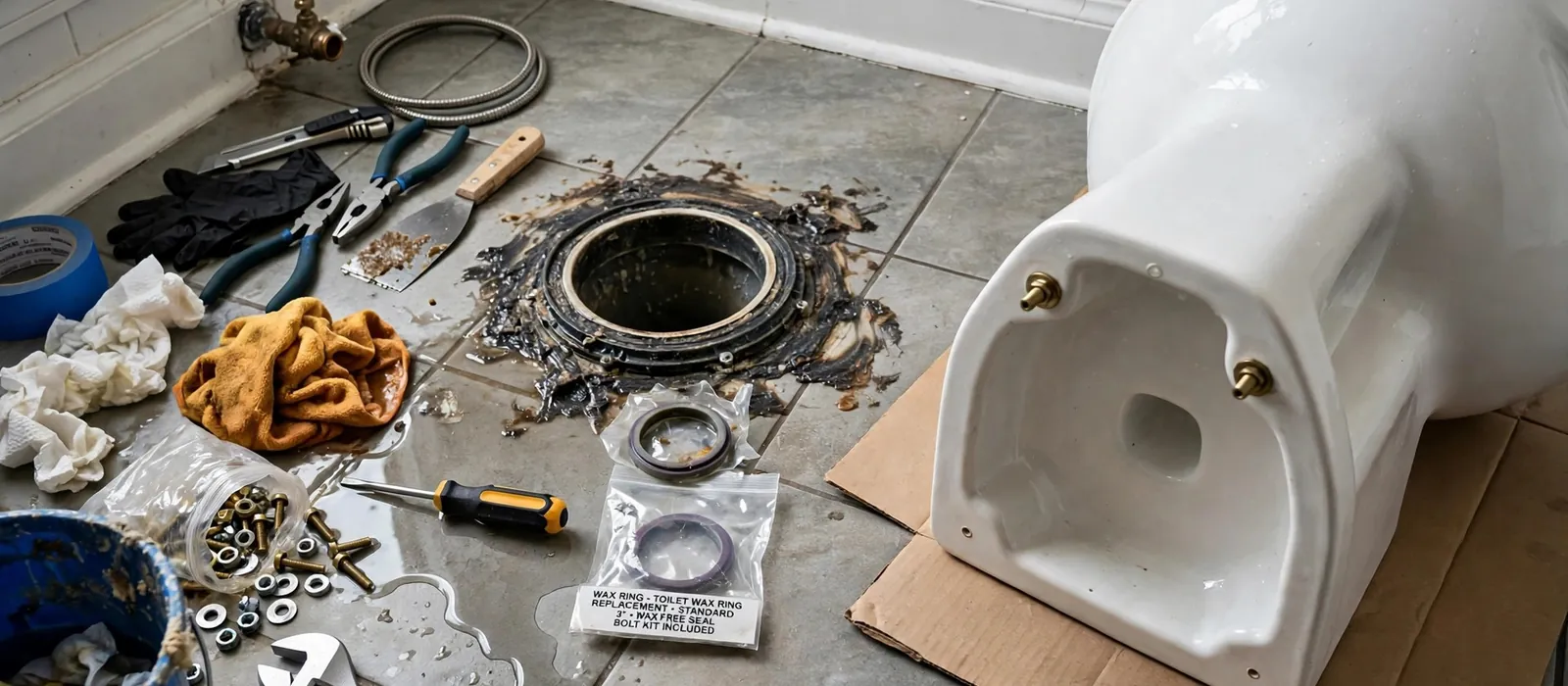
A leaking toilet base in Independence, KY almost always traces to a failed wax ring, a loose toilet, or a damaged flange underneath. The repair means lifting the toilet, replacing the seal and checking the flange it sits on. Before you do that, make sure the water is truly coming from the base.
Tank condensation, a loose supply line and a leaking tank-to-bowl gasket all put water on the floor too. This guide shows how to sort them out, then walks through the base repair step by step and flags the cases that need a plumber.
Tank leak, supply leak or base leak
Dry everything with a towel first, then watch where the new water appears. Each source leaves a different pattern.
| Where the water shows up | Likely source | Quick test |
|---|---|---|
| Only after a flush, around the base | Wax ring or flange seal | Flush and watch the base seam |
| Constant drip at the supply valve | Supply line or valve packing | Wrap dry tissue around the fitting |
| Drips from the tank bottom | Tank-to-bowl gasket or bolts | Color the tank water and check the bowl rim |
| Beads of water on the tank all over | Condensation | Wipe dry and see if it returns on humid days |
| Rocking toilet, damp floor | Loose closet bolts | Push gently side to side |
| Sewer smell plus damp base | Failed seal at the flange | Plan to lift the toilet |
If a tissue wrapped around the base stays dry between flushes but gets wet right after one, the wax ring has lost its seal.
What failure at the base looks like
The signs build slowly. Catching them early saves the subfloor.
A toilet that wobbles
Movement breaks the wax seal each time someone sits down, and the gap grows.
A faint sewer odor
Sewer gas escapes through any gap in the wax ring, even when no water is visible.
Water after each flush
The flush pushes pressure into the flange, and a bad seal lets water slip out around the base.
A stained or soft floor
Water that wicks into plywood turns it dark and spongy, and vinyl may lift at the edge.
Caulk gone moldy
Dark spots on the caulk line often mean moisture has been getting under the toilet for a while.
Replace the wax ring step by step
Shut off and empty
Close the supply valve, flush, and hold the handle to drain the tank. Sponge out the remaining water in the tank and bowl.
Disconnect and unbolt
Remove the supply line, pop off the bolt caps, and take off the nuts at the base. Hold the nuts with a wrench if the bolts spin.
Lift straight up
A toilet usually weighs somewhere between 60 and 100 pounds, so bend your knees or get help. Set it on towels or cardboard, not leaning against a wall.
Scrape and stuff
Scrape the old wax from the flange and the toilet horn with a putty knife. Stuff a rag in the pipe to block sewer gas while you work.
Check the flange
Look for cracks, rust, a bent ring or bolt slots that are broken. See the flange section below for what to do if it fails.
Set the new ring and toilet
Install fresh closet bolts, press a new wax ring onto the flange, and lower the toilet straight down. Do not rock it. Press with your weight to seat the ring.
Tighten and test
Tighten the nuts alternately, a half turn at a time, until the toilet stops moving. Reconnect the supply, flush several times, and check the base with a dry tissue.
Floor feels soft?
Stop using the toilet and call our 24/7 line.
Why over-tightening ruins a good seal
Porcelain is hard but brittle. Cranking the closet bolts down on one side tips the bowl, squeezes the wax out unevenly and can crack the base at the bolt holes. Snug is enough, and shims under the low side keep the bowl level without stress. If the toilet still wobbles after shimming, the problem is the floor or the flange height, not the nuts.
Judging the flange and the floor
The flange is the ring on the floor that the toilet bolts to and the drain pipe connects through. Check it every time you lift a toilet.
- Confirm the flange sits flat on the finished floor, not several inches below it.
- Look for cracks or breaks around the bolt slots, especially in thin plastic or old cast iron.
- Check for rust that has eaten through a metal ring.
- Press on the floor beside the toilet. Any give means a soft subfloor.
- Make sure the flange is screwed down and does not shift when pushed.
- Look for a thick stack of old wax rings, which can hide a poor fit.
- Dry-set the toilet without wax to see if it rocks on the floor.
- Stop and call a pro if you find rot, a broken drain pipe or an unfixable flange.
Why Independence homes vary under the toilet
Independence grew by annexation, with the Cherokee section in the 1960s, the Beechgrove area in the early to mid 1970s, and the extension to the Boone County line in 1981. Homes in the city span building eras, and each era tends to use different materials under the bathroom floor.
That variety matters for this repair, because flange types and floor conditions may differ from one house to the next. Older homes often have cast iron drain parts and newer ones often have plastic, but you cannot guess. Check by inspection every time. Lift the toilet, look at the flange, and test the floor before you buy a ring or a repair kit.
Source: City of Independence history page (annexation timeline)
Repair rings, extenders and other fixes
A cracked plastic or metal flange can often be repaired with a stainless steel repair ring that screws over the damaged area. If the flange sits below the finished floor, a spacer or extender ring raises the seat so the wax can seal. Wax rings with a plastic horn or foam collar are made for deeper gaps, but they will not rescue a crushed flange.
Match the ring to the job. A standard ring suits a flange level with the floor. A thick or extra-thick ring helps with a flange sitting slightly high or low. Never stack two plain rings as a shortcut, since that can leave a gap and make the seal worse.
When to call a plumber
Call a licensed plumber if the floor feels soft, if the flange is broken or the drain pipe has shifted, or if the leak keeps returning after a new ring. A rotted subfloor needs carpentry before the toilet goes back, and a crushed flange may mean cutting into the pipe.
Our toilet repair and installation service handles resets, flanges and wobbly bowls across Independence, Elsmere and Taylor Mill. If you cannot tell where the water is coming from, our leak detection team can trace it. Water spreading fast across a bathroom floor is a good reason to call our 24/7 line.
Frequently asked questions
Only if the toilet is loose and the wax ring is still sound. Tighten gently, a half turn at a time, and stop when the toilet stops moving. If water still shows after a flush, the seal has failed and the toilet must come up.
A wax ring can last many years if the toilet never moves. It fails sooner when the toilet rocks, the floor shifts or the flange is set too low. There is no fixed lifespan, so replace it any time the toilet is lifted.
They can. The city grew through annexations in the 1960s, 1970s and 1981, so houses span several building eras. Flanges may be cast iron, brass or plastic, and floor conditions vary. Check by inspection after lifting the toilet instead of assuming.
It is when water is spreading, the floor is soft, or sewer water is coming out. Close the supply valve, stop flushing and call our 24/7 line. A slow seep can wait for a scheduled visit but should not be ignored.
A bead of caulk helps keep mop water out and holds the bowl steady. Leave a small gap at the back or skip the caulk, so a future leak has a path to show itself instead of hiding under the toilet.
Sources and official contacts
Local details in this guide come from the sources below. They are the right offices for questions about the water and sewer systems or plumbing rules.
- Northern Kentucky Water District, customer service
Owns the service line from the main to the meter and publishes an annual water quality report.(859) 578-9898 - Kentucky Division of Plumbing
Oversees plumbing in the state, including the State Plumbing Code that sets the standards for our work. Verify a plumber's license or ask about permits here.(502) 573-0397