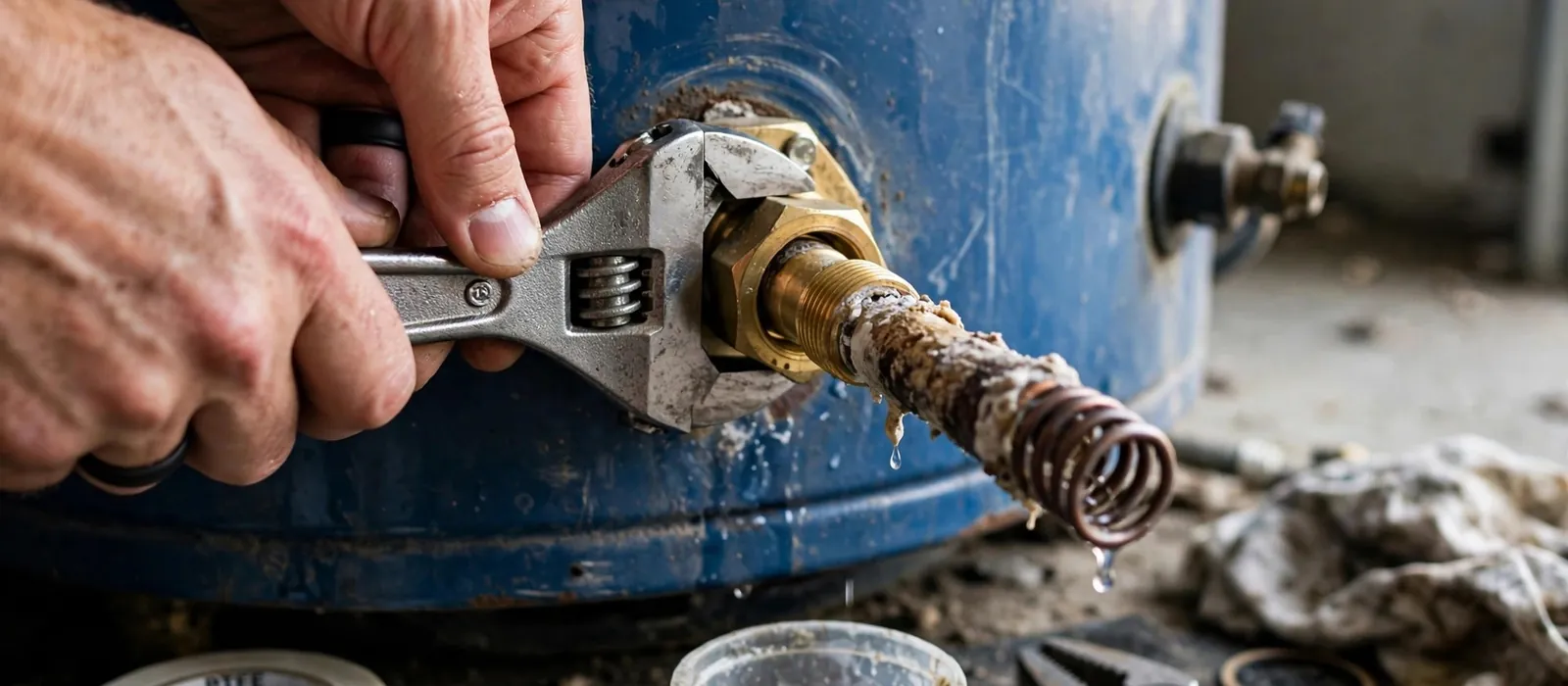
You cannot safely replace an electric water heater element without draining some water first. The element sits inside the tank, so pulling it out with the water level above it would send hot water into the room. A partial drain, lowering the level below the element, is the minimum.
That makes this a job for a careful homeowner with basic tools, as long as the power is off at the breaker and tested dead before anyone touches a wire. Here is how the partial drain works, how to test the old element, and where DIY ends for homes in Independence, KY.
Why the tank has to come down first
A standard electric tank has two elements. The upper one sits roughly a third of the way down the tank, and the lower one sits a few inches from the bottom. Each screws or bolts through the tank wall, and its heating rod stays submerged in water.
When you remove the element, you open a hole about 1 1/2 inches wide in the side of a full tank. Pressure and gravity push water straight out of that hole. For the upper element, you can drain a portion of the tank. For the lower element, you will drain nearly all of it.
Safety steps before you touch the heater
Skipping any of these can mean electric shock or scalding. Treat the list as a gate, not a suggestion.
- Switch off the dedicated double-pole breaker for the water heater, which is usually 30 amps.
- Tape the breaker or tell everyone in the house so no one switches it back on.
- Remove the metal access panels and fold back the insulation to expose the thermostats and wiring.
- Use a non-contact voltage tester on each wire and terminal, and confirm a reading of zero.
- Shut the cold water supply valve on top of the heater.
- Let the water cool if the tank was recently heating, since the drain water can be hot enough to scald.
- Wear gloves and safety glasses, and put towels around the base.
- Stop if you see scorched wires, melted insulation or water inside the control compartment.
The partial drain and swap, in order
Connect a hose to the drain valve
Screw a standard garden hose onto the drain valve near the bottom of the tank. Run the other end to a floor drain or outside, lower than the valve.
Open a hot tap upstairs
Open a hot faucet at a sink to let air into the system. Without it the tank will glug and drain very slowly.
Open the drain valve and lower the level
For the upper element, drain about 10 gallons from a typical 40 or 50 gallon tank, then check by opening the access panel. For the lower element, drain until the flow slows to a trickle.
Disconnect the wires and remove the element
Photograph the wiring, loosen the terminal screws and pull the wires aside. Use a 1 1/2 inch element socket to unscrew a threaded element, or remove the four bolts on a flange style.
Clean the opening and fit the new element
Wipe the tank wall where the old gasket sat. Install the new element with its new gasket, tighten snugly, and match the wattage and voltage printed on the old part and the tank label.
Refill before restoring power
Close the drain valve, open the cold supply, and keep the hot tap open until water runs steady with no sputtering. Check for drips around the element. Only then reconnect the wires and switch the breaker on.
Not comfortable with wiring?
A licensed plumber can test and swap the element safely.
Why a dry element burns out in seconds
An element has no thermostat of its own. The water carries the heat away. If power reaches an element sitting in air, the sheath can reach glowing temperatures within a few seconds and fail, and a trapped air pocket in a refilled tank can do the same to the upper element. That is why the refill step comes before the breaker, and why you wait for steady water at the hot tap.
Is it the element, the thermostat or something else?
Do not buy a part until you know which one failed. A short test with a multimeter set to ohms tells you most of the story.
| Symptom | Most likely cause | How to check |
|---|---|---|
| Lukewarm water, never hot | Failed lower element | Disconnect one wire and test across terminals for continuity |
| Hot water runs out fast | Failed upper element | Same test on the upper element |
| Breaker trips right away | Shorted element or ground fault | Test from a terminal to the mounting plate, any reading is a fault |
| No hot water at all | Tripped reset or bad thermostat | Press the red reset button, then test voltage with power on, using a pro if unsure |
| Rumbling or popping noises | Scale on the element | Inspect after removal and flush the tank |
| Water leaks at the element | Bad gasket or loose element | Power off, then inspect the seal |
A healthy 4500 watt element usually reads roughly 10 to 15 ohms. An open circuit or a connection to the tank means the part is done.
Hard water and elements in Independence
Northern Kentucky Water District's 2023 water quality report shows an average hardness of about 7 grains per gallon across its systems. That is moderately hard to hard water. Heated water drops minerals out as scale, and the crust forms on the hot surface of the element.
The practical result is that an old element may come out coated in white or tan scale, and the bottom of the tank may hold a layer of sediment. Take advantage of the open drain to flush the tank for a few minutes. Scale insulates the element, makes it run hotter, and shortens its life, so a flushed tank helps the new part last.
Source: NKWD 2023 Water Quality Report (utility)
When to stop and call a plumber
Call a licensed plumber if the breaker will not stay off, if wiring looks burned, or if you cannot get a voltage reading of zero. Also call if the element will not unscrew, since forcing it can crack the tank opening. Gas heaters have no elements, and gas work is never a DIY job.
Sometimes the right answer is a new tank. Heaters with a leaking tank, heavy corrosion or a long service life are not worth another element. Our water heater repair service diagnoses the failure first, and water heater replacement is there when repair does not make sense. We serve Independence, Taylor Mill and Edgewood, and our 24/7 line is open if you are left without hot water or find water pooling at the base.
Frequently asked questions
No. The lower element sits just above the bottom of the tank, so you need to drain nearly all the water. Draining only a little works for the upper element at best.
Yes, every time. Turning down the thermostat does not cut power to the element terminals. Switch off the breaker and confirm zero voltage with a tester before you remove any wire.
Disconnect its wires and test across the two terminals with a multimeter on ohms. A normal element reads a few ohms to about 15. No reading means a burned-out coil, and a reading to the tank wall means a ground fault.
It can. NKWD's 2023 report shows about 7 grains per gallon across its systems, and scale on the element makes it run hot. Flushing the tank when you swap the part removes loose sediment and gives the new element a cleaner start.
Turn the power off, close the supply, and check that the gasket is seated flat and the element is tight. If it still drips, drain again, fit a fresh gasket, and call a plumber if it persists.
Sources and official contacts
Local details in this guide come from the sources below. They are the right offices for questions about the water and sewer systems or plumbing rules.
- Northern Kentucky Water District, customer service
Owns the service line from the main to the meter and publishes an annual water quality report.(859) 578-9898 - Kentucky Division of Plumbing
Oversees plumbing in the state, including the State Plumbing Code that sets the standards for our work. Verify a plumber's license or ask about permits here.(502) 573-0397