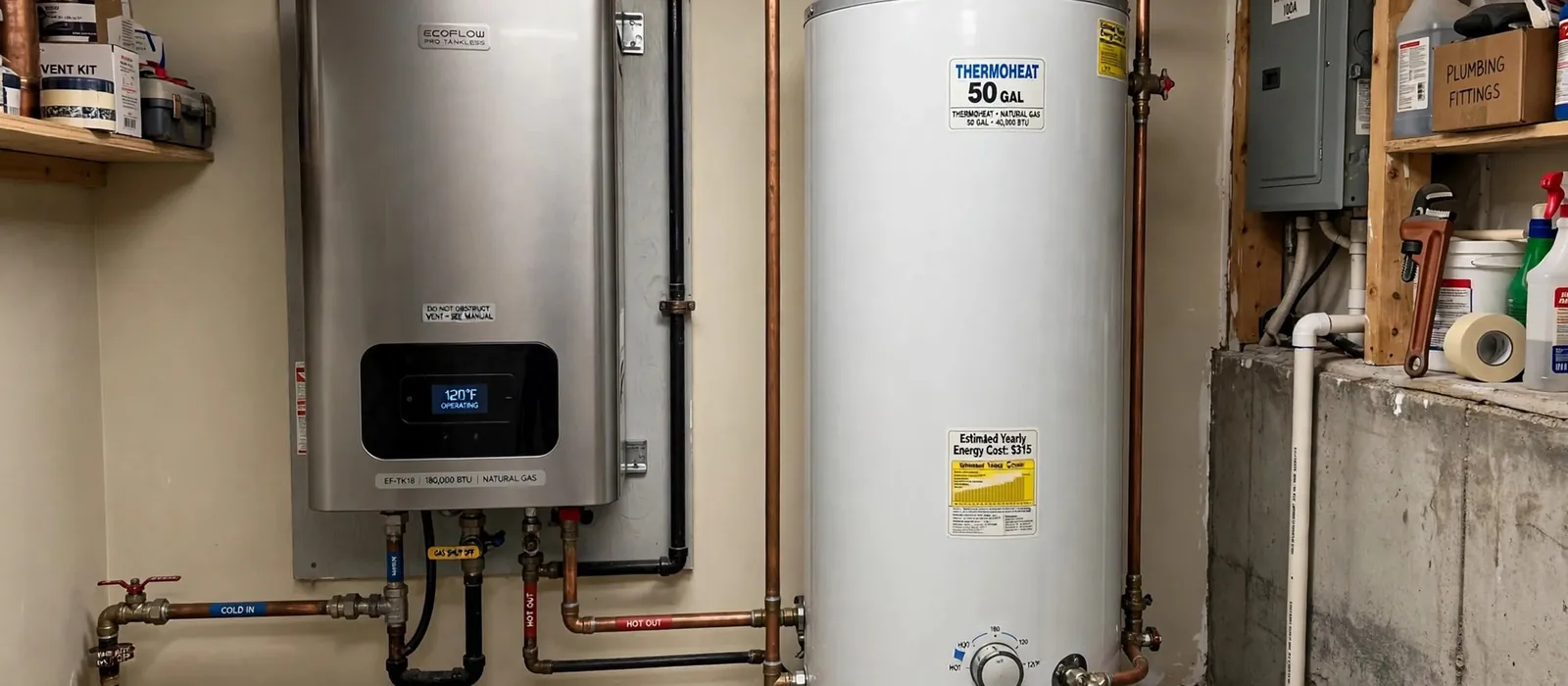
For most homes in Independence, KY, a tankless water heater costs more to install than a tank model, and the reason is mostly the work around the unit, not the unit alone. Tankless saves money on running costs over time, but only if your usage, fuel, and lifespan line up. Payback is a calculation, not a promise.
This guide compares the two systems on installation scope, operating cost, lifespan, and maintenance. It shows how to build a simple payback estimate with your own utility bills, and it flags the situations where a plain tank is the smarter buy. No dollar amounts appear here, because your home sets the numbers.
Side-by-side: what each system asks of your house
Start with the comparison. Each row shows a place where the two installs diverge, which is where the cost gap comes from.
| Item | Tank heater | Tankless heater |
|---|---|---|
| Hot water supply | Stored volume, runs out after heavy use | On demand, limited by flow rate |
| Gas line | Often reuses existing 1/2 inch line | May need a larger line for the higher burner load |
| Venting | Atmospheric or power vent in many cases | Sealed stainless or PVC vent, often a new route |
| Electrical | Gas units need none, electric units need a large circuit | Gas units need an outlet, electric units need very heavy wiring |
| Space | Floor footprint of a barrel | Wall-mounted, frees floor space |
| Typical service life | About 10 to 15 seasons | Often 20 or more with care |
| Maintenance | Drain sediment, check the anode | Descale the heat exchanger, clean the inlet screen |
Why the install is the bigger price gap
A tank swap usually reuses what is already there: the gas line, the flue, the water connections. A tankless install often touches all of them. The burner on a gas tankless unit is much larger than a tank's, so a thin gas pipe can starve it. Many homes need a bigger line from the meter.
Venting changes too. Tankless units produce cooler, wetter exhaust, so they use sealed plastic or stainless vent pipe, not the old metal flue. The old chimney path may be useless. Add a condensate drain for high-efficiency models, plus isolation valves for flushing, and the work scope grows quickly.
Working out your own payback, step by step
Payback logic is simple arithmetic. You need a pencil, your last twelve utility bills, and a quote for each option.
Find your water heating share
Water heating is commonly one of the largest slices of a home's gas or electric use. Estimate it from summer bills when heating and cooling are low.
Get both installed quotes
Ask for the full installed price of each option, with vent, gas line, and electrical work itemized. Compare the difference, not the totals.
Estimate the running-cost gap
Ask for the efficiency rating on each unit. A tank loses heat while it sits, and tankless does not. Apply the efficiency gap to your water heating share.
Divide the install gap by yearly savings
If the extra install cost is covered by annual savings in a number of years that is shorter than the unit's life, payback works. If not, a tank wins.
Stress-test the result
Redo the math with a smaller savings figure. If the answer still looks good, the choice is sturdy.
Comparing two quotes?
Call our 24/7 line and we will walk through the line items with you.
Why flow rate matters more than tank size
A tankless unit is rated in gallons per minute at a given temperature rise. In winter, incoming water is colder, so the unit has more heating to do and its output drops. A unit that handles one shower and a dishwasher in summer may struggle with two showers in January.
That is why sizing is done by the number of fixtures running at once, not by the number of people in the house. Undersizing is the most common regret with tankless, and it cannot be fixed without swapping the unit.
Situations that tip the choice
Large household, heavy simultaneous use
Several showers at once need a large or paired tankless setup, which raises the install cost. A big tank can be simpler.
Small household, steady daily use
One or two people often see the best tankless savings, since a tank would keep a large volume hot for little use.
Short stay planned
If you may sell within a few years, the savings may not repay the install difference before you move.
Tight utility closet
A wall-hung tankless unit can free a closet or basement corner when floor space is scarce.
Existing vent in poor shape
If a vent needs replacing either way, the extra tankless vent cost counts for less in the comparison.
All-electric home
Electric tankless units draw a lot of power at once, so the panel and wiring may need upgrades first.
Local water, hardness, and the descaling schedule
Northern Kentucky Water District's 2023 water quality report shows average hardness of about 7 grains per gallon across its systems, which counts as moderately hard to hard. Hardness minerals leave scale on any hot surface. In a tankless unit, scale builds on the narrow heat-exchanger passages, which reduces flow and efficiency.
For that reason, tankless owners should plan on periodic descaling, a vinegar or descaling-solution flush through isolation valves. Ask your installer to include those valves, because adding them later costs extra. The same hardness affects tanks, but a tank hides it under a layer of sediment at the bottom instead of choking a coil.
Source: NKWD 2023 Water Quality Report (utility)
What to confirm before signing either quote
- The gas line size and whether it can feed a tankless burner.
- The vent material, route, and length for the new unit.
- The unit's flow rate at your winter incoming water temperature.
- Whether isolation valves for descaling are included in the price.
- Where condensate drains and who adds the drain line if needed.
- What the labor and parts coverage is, in writing.
- That the plumber is licensed and insured, and the price is clear before work starts.
When to call a plumber and when a tank is enough
If your gas line is old, your vent path is unclear, or you are unsure about electrical capacity, call a plumber before you buy a unit online. A wrong purchase is hard to return once connected. Our tankless water heater team can size a unit to your fixtures and check the gas and vent first.
If your tank is leaking at the base or the tank wall is weeping, tankless-versus-tank is a quick decision, because a tank swap restores hot water fastest. Our water heater installation crews also work around Walton and Elsmere, and our 24/7 emergency line covers failures that cannot wait.
Frequently asked questions
Usually, but not always. It avoids the standby heat loss of a stored tank. For a home with very low hot water use, the savings can be too small to matter. Run the payback math with your own bills.
NKWD's 2023 report shows about 7 grains per gallon across its systems, which is moderately hard to hard water. Scale forms inside the heat exchanger over time. A periodic flush with descaling solution keeps flow and efficiency up. Skipping it can shorten the unit's life.
Sometimes. A tankless burner draws much more gas at once than a tank burner, so a small line may starve it. A plumber can check the pipe size and length. If it is too small, expect a line upgrade in the scope of work.
It gives hot water as long as it runs, but only up to its flow rating. Run too many fixtures and the temperature drops. Sizing to your peak use is the fix.
Often, yes. Good tankless units can outlast tanks when serviced, mainly because they avoid sitting water and tank rust. That longer life helps payback, but only if you stay long enough to use it.
Sources and official contacts
Local details in this guide come from the sources below. They are the right offices for questions about the water and sewer systems or plumbing rules.
- Northern Kentucky Water District, customer service
Owns the service line from the main to the meter and publishes an annual water quality report.(859) 578-9898 - Kentucky Division of Plumbing
Oversees plumbing in the state, including the State Plumbing Code that sets the standards for our work. Verify a plumber's license or ask about permits here.(502) 573-0397