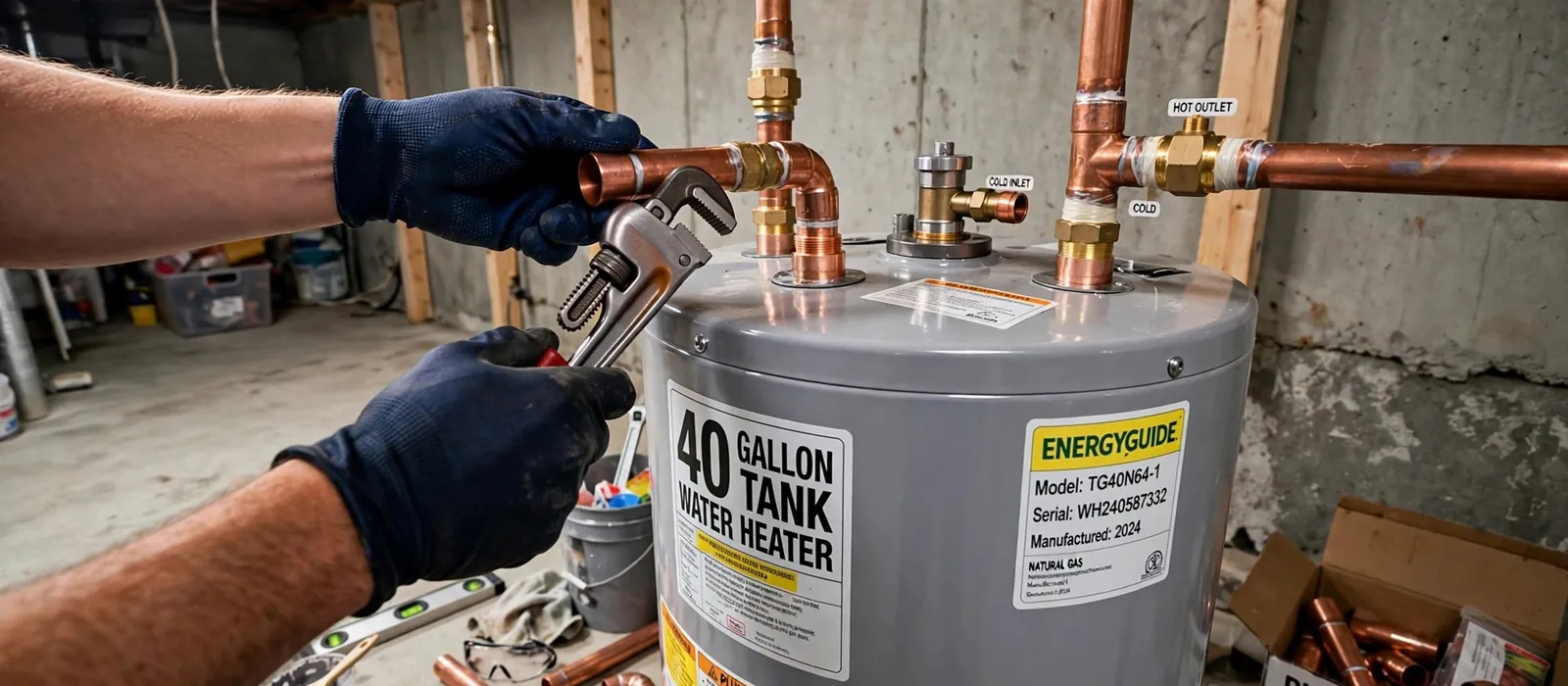
Water heater replacement cost in Independence, KY comes down to five things: the size of the tank, the fuel it burns, how it vents, what the old setup needs to meet current standards, and how hard the unit is to reach. Two houses with the same model can end up with very different totals because of those job details.
This post lists every major cost driver for a standard tank replacement, explains why each one moves the price, and shows what to ask before you approve work. We do not print dollar figures here because the real number depends on your home, and a fair quote is written after a plumber sees the tank, the venting, and the room it sits in.
Start with the unit, not the labor
The tank itself is the first line on any bill. Capacity matters most. A typical home tank holds 40 or 50 gallons, while larger households step up to 65 or 80 gallons. A bigger tank costs more to buy, weighs more, and sometimes needs a stronger stand or a larger pan underneath.
Efficiency grade comes next. A basic builder-grade model has a thin layer of insulation and a short warranty period on the tank. A higher-grade model adds thicker foam, a longer-rated anode rod, and a better burner or heating element. You pay more at purchase and often less to run it every month.
The cost drivers, one at a time
Every replacement bill is the sum of these items. If a quote lumps them together, ask for them to be listed separately so you can compare one offer against another.
Fuel type and conversion
Swapping a gas unit for another gas unit is the simplest path. Switching from gas to electric, or the other way, means new gas piping, new wiring, a new breaker, or all three.
Venting condition
A gas heater needs a flue that pulls exhaust outside without leaking. If the old vent is rusted, undersized, or sloped wrong, it must be corrected, and that adds parts and time.
Code-driven add-ons
New expansion tanks, drain pans, and sediment traps are common additions on a swap. Ask your plumber which ones apply to your job and why, since requirements vary.
Access and location
A heater in a basement with a straight stair is easy. One in a cramped attic, a tight closet, or up a narrow staircase takes longer to haul out and set.
Haul-away and disposal
A full 50-gallon tank weighs over 100 pounds when drained and awkward to move. Taking the old unit away is usually a labor line item.
Insurance often covers sudden damage, such as a burst tank that floods a finished room. It rarely covers a heater that simply wore out, so read your own policy before you count on help.
Gas, electric, and what each swap involves
The fuel decision changes the scope of work more than any other single choice.
| Job type | What changes | Cost pressure |
|---|---|---|
| Gas to gas, same size | Disconnect, reconnect gas flex line and flue, new water connectors | Lowest scope of the group |
| Electric to electric | New heating elements wired to the existing 240-volt circuit | Low scope if wiring is sound |
| Gas to electric | New circuit, breaker, and wiring, plus capping the gas line | Higher, adds electrical work |
| Electric to gas | New gas line, vent through roof or wall, combustion air | Highest of the four |
| Larger tank than before | May need a bigger pan, stand, or more floor space | Raises purchase price |
| Move the heater to a new spot | Extends water, gas or electric, and vent runs | Scope grows with distance |
Heater leaking now?
Call our 24/7 line and shut the cold valve above the tank first.
How a standard replacement job unfolds
Walk-through and measurements
The plumber checks the tank label, vent path, shutoff valves, and the clearance around the unit before writing a price.
Water off, power or gas off
The cold supply is closed, the gas valve or breaker is switched off, and the tank is drained into a hose or bucket.
Old unit out
Connections are cut or unthreaded, the tank is tipped onto a dolly, and the old pan or debris is cleared away.
New unit set and connected
The new tank is leveled, water and gas or electric lines are hooked up, and a relief valve with a discharge pipe is installed.
Fill, purge, and test
The tank fills with a hot tap open to bleed air. Then the burner or elements are brought on and connections are checked for leaks and proper draft.
The part that shortens or extends a heater's life
Inside every steel tank is a sacrificial anode rod, usually magnesium or aluminum, that corrodes in place of the tank wall. Once the rod is eaten away, the steel starts to rust. That is why a model with a longer-rated rod costs more up front but can outlast a cheaper unit.
A higher purchase price is not wasted money if it buys several extra years of tank life. Weigh it against how long you plan to stay in the home, and against how hard your water is on the tank.
Kentucky licensing and permits for your replacement
Plumbing in Kentucky is overseen by the Division of Plumbing, part of the state Department of Housing, Buildings and Construction. Before anyone touches your water heater, check that the plumber holds a license by contacting the Kentucky Division of Plumbing. Our plumbers are licensed and insured, and you are free to verify that independently.
Ask whether a permit applies to your job and who pulls it. Permit rules vary, so ask the Kentucky Division of Plumbing or the City of Independence rather than relying on a contractor's guess. A plumber who is open about permits is usually open about the rest of the bill, too. We handle swaps for neighbors in Erlanger and Edgewood with the same itemized approach.
Source: Kentucky DHBC Division of Plumbing (state agency)
Questions to ask before you approve a quote
- What size and efficiency grade is the new tank, and why that one?
- Is the old vent being reused, replaced, or corrected?
- Which code add-ons are included, such as an expansion tank or drain pan?
- Is haul-away and disposal of the old unit in the price?
- Who pulls any permit, and what does the plumber charge for it?
- What does the manufacturer cover, and what does labor coverage look like?
- Is the price clear before work starts, with no add-ons after the job begins?
When replacement beats repair
A heater in its second decade of service with a leaking tank, rusty hot water, or a failed gas valve is usually past repair. A leak from the tank body cannot be patched. If the problem is a thermostat, element, or pilot part, a water heater repair visit may buy you more time.
If you are weighing a full swap, our water heater replacement crews can inspect the unit and explain which route makes sense. For an after-hours leak, call our 24/7 emergency line and shut off the cold supply valve above the tank while you wait.
Frequently asked questions
Most of the gap comes from what is included. One quote may cover the vent fix, an expansion tank, a drain pan, and haul-away. Another may list only the tank and basic labor. Ask each plumber for a line-by-line scope.
Not always. A larger tank has more surface to lose heat, but it also keeps hot water ready for big households. If your current tank runs out too fast, a larger one may be worth the standby loss.
Gas and 240-volt electric work carry real risk, including carbon monoxide and shock. Mistakes with the relief valve or vent can be dangerous. A licensed plumber also knows which local steps apply to your job.
Contact the Kentucky Division of Plumbing, which oversees plumbing in the state, and ask them to confirm the license. Ask about permits for your specific job at the same time. Rules vary, so get the answer from the state or the city.
Often yes, because a planned swap lets you compare quotes and pick a time. An emergency failure leaves you with a flooded floor and few options. A tank that is a decade old or showing rust at the base is worth planning for.
Sources and official contacts
Local details in this guide come from the sources below. They are the right offices for questions about the water and sewer systems or plumbing rules.
- Northern Kentucky Water District, customer service
Owns the service line from the main to the meter and publishes an annual water quality report.(859) 578-9898 - Kentucky Division of Plumbing
Oversees plumbing in the state, including the State Plumbing Code that sets the standards for our work. Verify a plumber's license or ask about permits here.(502) 573-0397