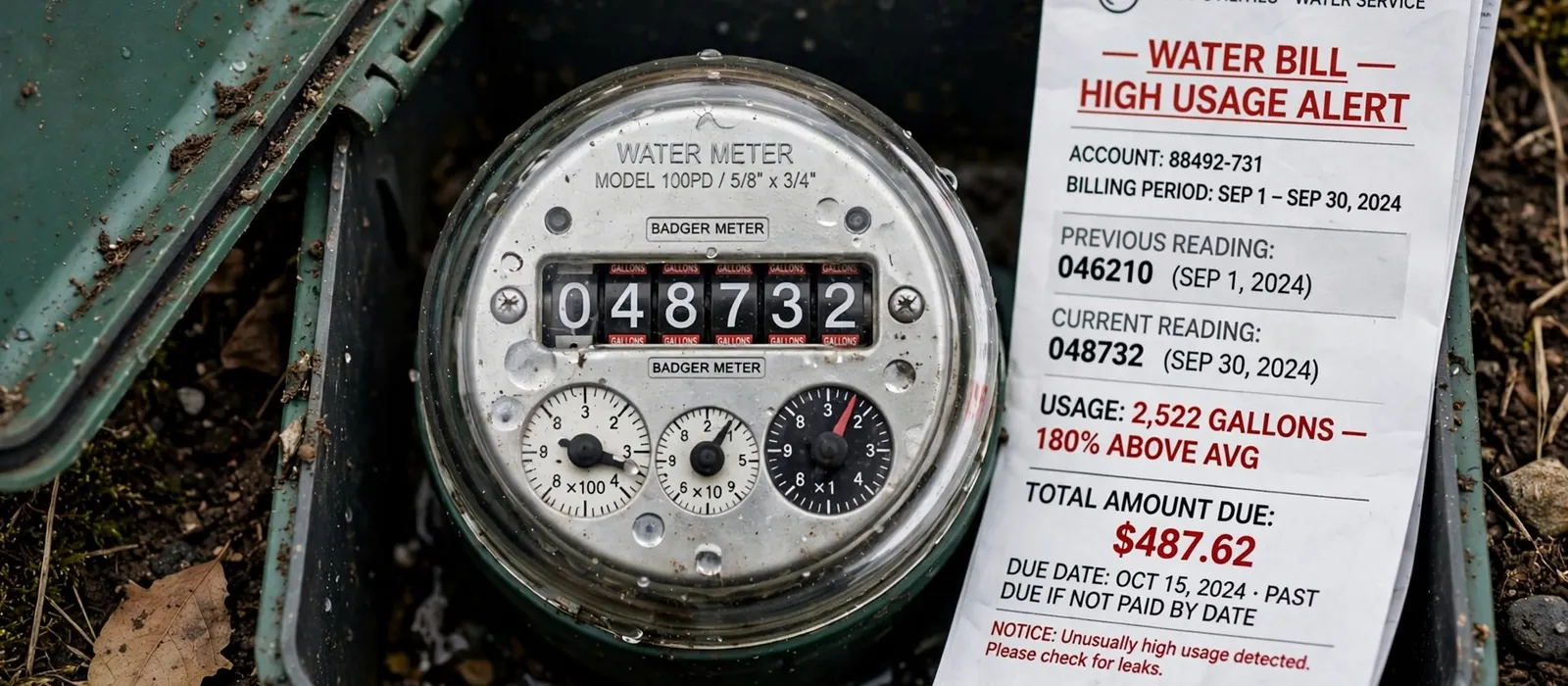
A high water bill in Independence, KY usually comes from one of four things: a leaking toilet, outdoor watering, a hidden leak between the meter and the house, or a billing period that was longer than usual. Each one leaves a clue you can check yourself in under an hour, starting with the water meter.
The meter does not lie. If it keeps moving when every fixture is off, water is going somewhere you did not intend. If it sits still, the bill likely reflects use or timing. Work through the steps below in order, and you will either find the leak or have the proof you need to ask the utility to look closer.
Quick sorting: what a jump usually means
Start by matching the pattern of the increase to the most likely source.
| Pattern | Most likely cause | First check |
|---|---|---|
| Gradual rise over several bills | Slow leak that is getting worse | Dye test every toilet |
| Sudden spike in summer | Sprinklers, pool fill, or hose use | Zone run times and timers |
| Spike in one bill only | Longer billing period or an estimated read | Read dates on the bill |
| Higher use with no change in habits | Leak on the owner's side of the meter | Meter test with everything off |
| Higher use after guests or a new baby | More showers, laundry, and flushes | Compare daily use to before |
| Steady high use, meter spins at night | Running toilet or underground leak | Look at the meter low-flow dial |
No single row is definite, so use the table as a map and then confirm with the tests in the next sections.
Check the meter first
Turn off every faucet, the ice maker, the dishwasher, and the washing machine. Then open the meter box and look at the dial. Most meters have a small triangle or flow wheel that spins when even a tiny amount of water moves through. If it spins with everything off, you have a leak somewhere after the meter.
Write down the full reading, wait one hour without using any water, and read it again. A change means water is escaping. Now close the main valve inside the house and check again. If the meter stops, the leak is inside the house. If it keeps moving, the leak is in the buried line between the meter and the house.
Toilets, the quiet leaker
Toilets cause more surprise bills than any other fixture, and many leak silently.
Worn flapper
The rubber seal at the bottom of the tank softens and warps with age, then lets water seep into the bowl. You may hear nothing at all.
Fill valve stuck open
If the tank water level sits above the overflow tube, water pours down the tube all day. This is often loud, but not always.
Bad chain length
A chain that is too short holds the flapper open slightly. A chain that is too long can slip under it and block the seal.
Cracked tank or bowl
A hairline crack can drip onto the floor or into the base. Check for damp spots around the base of the toilet.
The dye test
Put a few drops of food coloring in the tank and wait 15 minutes without flushing. Color in the bowl means the flapper is leaking.
Think you have a leak?
Call our 24/7 line and a licensed plumber can help trace it.
Outdoor watering and seasonal swings
A sprinkler system uses far more water than most people expect. One zone running 20 to 30 minutes can use hundreds of gallons, and a typical yard has four to eight zones. A timer that was set for spring and never adjusted can double the bill by midsummer.
Check the controller for run times and days. Look for broken heads that spray a fan of water onto the pavement, and for valves that stick open. Hose bibs are another source, since a spigot that drips or a hose left running while filling a pool or washing a truck adds up in a hurry.
How small leaks add up faster than you think
A drip at one drop per second sounds harmless, but it adds up to several thousand gallons in a year. A pinhole in a copper pipe under pressure can spray a fine mist that you never see, and a cracked underground line can leak for months because the soil absorbs the water. Pressure in a typical home is around 50 to 70 psi, so a leak runs around the clock.
A water heater that weeps from its pressure relief valve or a corroded supply connector can do the same. These small leaks rarely cause obvious damage, which is why a bill is often the first and only warning.
Reading your bill like a detective
Compare billing dates
Look at the start and end of each period. A bill that covers 35 days will look bigger than one covering 28, even if your daily use is the same.
Look for estimated reads
If the bill says estimate, the next actual read may swing the other way. Compare the meter reading on the bill to the number on your meter today.
Divide by days
Work out gallons per day for each period. If daily use went up and your habits did not change, suspect a leak.
Match to the season
Summer and fall watering explain a large share of increases. Compare to the same months last year if you have those bills.
Write down your findings
Keep notes with dates and meter readings. If you call the utility, those notes get you answers faster.
Who handles what in Independence
The Northern Kentucky Water District owns the service line from the main to the meter, and the property owner owns the line from the meter to the house. A leak on the owner's side of the meter, including the buried run to your foundation, is the homeowner's repair. Call NKWD customer service at 859.578.9898 with your readings if you suspect a meter problem or want to ask about a meter test.
For water quality questions such as taste or odor, NKWD's water quality line is 859.441.0482. That line is for the water itself and does not explain the bill, so use customer service for charges.
Source: NKWD 2023 Water Quality Report (utility)
When to call a plumber
Call a plumber when the meter moves with all fixtures off and you cannot find the source, or when you find a leak you cannot repair. Our licensed plumbers use leak detection tools to trace hidden leaks without digging up the yard, and can replace a worn toilet part or an entire fixture. See our page on toilet repair and installation for the common fixes.
We serve Edgewood and Walton as well, though Walton runs its own water utility, so billing questions there go to the city. The cost of a repair depends on the pipe depth, material, length of the run, and how much surface must be restored, and you get a clear price before work starts.
If water is gushing, shut off the main valve and call our 24/7 line.
Frequently asked questions
Add a few drops of food coloring to the tank and wait 15 minutes without flushing. If color shows in the bowl, the flapper is leaking. A toilet that refills by itself or hisses is another sign.
Yes. Water that escapes underground still passes through the meter, so you pay for it. The Northern Kentucky Water District owns the line up to the meter, and you own the rest, so this repair falls to you.
You can ask. Call NKWD customer service at 859.578.9898 with your meter readings and billing dates. Do your own all-fixtures-off check first so you know whether the meter moves.
The billing period may have been longer, the read may have been estimated, or you may have used more water for a fill, a pool, or watering. Compare gallons per day, not the total, to see if use really changed.
NKWD's water quality line is 859.441.0482. For charges and meters, use customer service at 859.578.9898. NKWD owns the line from the main to the meter and the owner owns the rest, so a leak past the meter is a plumber's job.
Very often. Several zones running for 20 to 30 minutes each can use hundreds of gallons per cycle. Check run times, broken heads, and any valve that sticks open.
Sources and official contacts
Local details in this guide come from the sources below. They are the right offices for questions about the water and sewer systems or plumbing rules.
- Northern Kentucky Water District, customer service
Owns the service line from the main to the meter and publishes an annual water quality report.(859) 578-9898 - Kentucky Division of Plumbing
Oversees plumbing in the state, including the State Plumbing Code that sets the standards for our work. Verify a plumber's license or ask about permits here.(502) 573-0397